AI Maturity Ladder
AI transformation is not just a technology rollout. It is an organizational evolution in how intelligence is governed, trusted, and turned into sustainable value.
Why AI Maturity Matters
Many organizations invest in AI tools, pilots, and models, yet fail to create durable business or organizational value. The challenge is often not the technology itself, but the absence of institutional readiness: governance, accountability, decision design, and long-term value alignment.
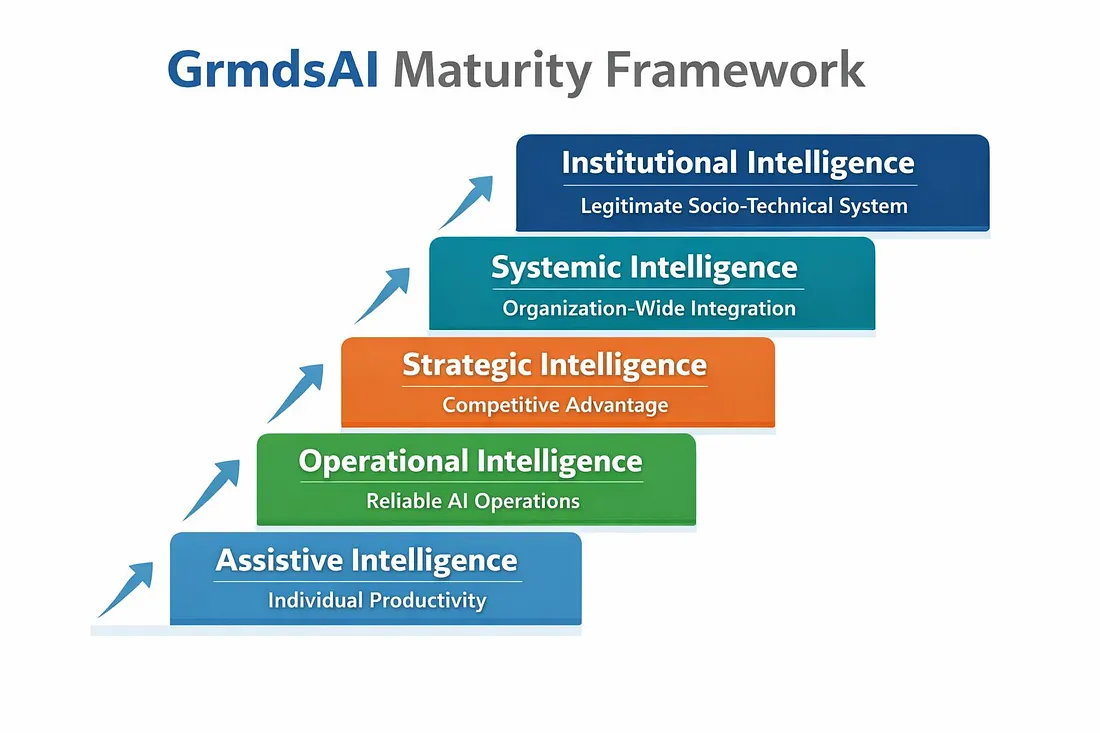
The GrmdsAI AI Maturity Ladder helps organizations understand where they stand today and what they need next to move from isolated experimentation toward scalable, trustworthy, and institution-ready AI.
The 5-Stage AI Maturity Ladder
- 1. Assistive Intelligence: AI is used mainly to augment individual work and productivity.
- 2. Operational Intelligence: AI is embedded into repeatable workflows and functional processes for reliable AI operations.
- 3. Strategic Intelligence: AI initiatives are aligned with business priorities, planning, and competitive advantage.
- 4. Systemic Intelligence: AI becomes part of shared enterprise decision systems with governance, feedback loops, and organization-wide integration.
- 5. Institutional Intelligence: AI is governed, trusted, auditable, purpose-aligned, and sustained as part of a legitimate socio-technical system.
What Changes as Maturity Increases
As organizations climb the maturity ladder, AI shifts from individual tools to enterprise decision systems. Success moves beyond model accuracy toward measurable decision quality, multi-capital impact, governance, and sustainable institutional value.
The key challenge is that many organizations stall before reaching systemic maturity. They may have strong models and active pilots, but lack the shared artifacts, accountability, governance, and organizational design needed to scale AI responsibly.
Holistic Computation and ASI
Holistic Computation supports AI maturity by integrating 4Capital value orientation, explicit causal reasoning, ecosystem design, and the 4E workflow: Equation, Estimation, Evaluation, and Execution.
Artificial Spiritual Intelligence adds the ethical and institutional layer: values awareness, purpose alignment, virtue reasoning, and long-horizon impact. Together, HC and ASI help AI systems become effective, governed, explainable, trusted, and aligned with broader organizational value.
Quick Self-Assessment
- Are AI tools embedded in standard workflows with clear owners?
- Do you have an explicit AI strategy aligned with enterprise objectives?
- Do you maintain shared data, model, and decision infrastructure?
- Do you monitor decision outcomes beyond model accuracy?
- Are recourse, override, and accountability mechanisms operational?
- Is there executive or board-level oversight for AI governance?
A Practical Roadmap for AI Transformation
Assistive to Operational: focus on repeatable workflows, pilot outcomes, adoption rates, and operational ownership.
Operational to Strategic: align AI with enterprise priorities, create a strategic roadmap, and define value beyond short-term efficiency.
Strategic to Systemic: build enterprise decision catalogs, shared data and model infrastructure, and cross-functional governance.
Systemic to Institutional: embed recourse, oversight, ethical intelligence, long-horizon impact assessment, and executive accountability.
Know Your Level
Assess current AI readiness, governance, workflows, decision systems, and value creation.
Move with Purpose
Prioritize the next maturity step based on organizational capability, risk, and measurable value.
Build Institutional Capability
Create trusted, auditable, purpose-aligned AI capability beyond individual tools and pilots.
From Assistive AI to Institutional Intelligence
RMDS Lab helps customers climb the AI maturity ladder with assessment, training, solutions, ecosystem support, Holistic Computation, and responsible AI transformation.
Join the RMDS AI Ecosystem
Get AI maturity insights, resources, and updates.